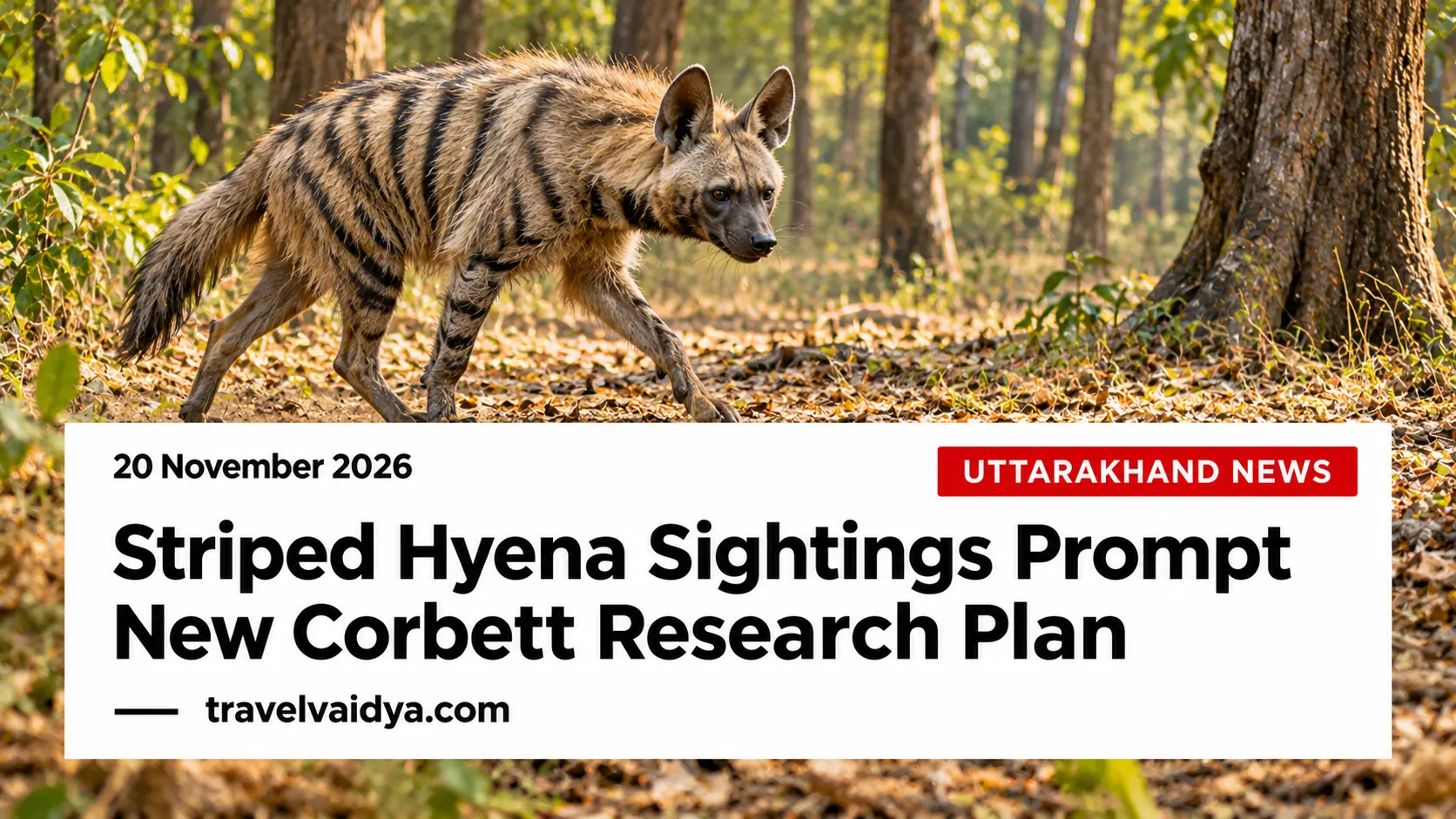
Ramnagar, Uttarakhand | 20 November 2026: Striped Hyena Sightings in Jim Corbett Tiger Reserve, one of India’s best-known wildlife destinations, is drawing attention for an animal rarely associated with its popular tiger safaris: the striped hyena.
Following reported sightings in the reserve’s Bijrani Zone and surrounding forest areas, authorities are planning further research into the species’ presence, habitat and movement patterns.
According to a 20 November report by Amar Ujala, forest officials want to establish whether striped hyenas are permanent residents of the landscape or occasional visitors moving through connected habitats.
The development highlights a lesser-known aspect of Corbett’s biodiversity and raises important questions about the conservation of wildlife beyond the reserve’s famous tiger population.
Corbett Authorities Plan Research After Striped Hyena Sightings in Jim Corbett
Forest personnel reportedly observed a striped hyena during patrols in the Bijrani Zone of Corbett Tiger Reserve.
The sighting has renewed interest in studying the species, which has appeared in earlier wildlife surveys but has not been consistently documented.
Reserve director Dr Saket Badola described the recent observations as encouraging, according to Amar Ujala.
The proposed research is expected to investigate where striped hyenas occur, which habitats they use, what food resources are available and how they move through the reserve and adjoining forest areas.
What Was Reported in the Bijrani Zone?
Bijrani is among Corbett’s established tourism zones, known primarily for tiger, elephant and deer sightings.
The recent hyena observation was reported by forest personnel rather than tourists.
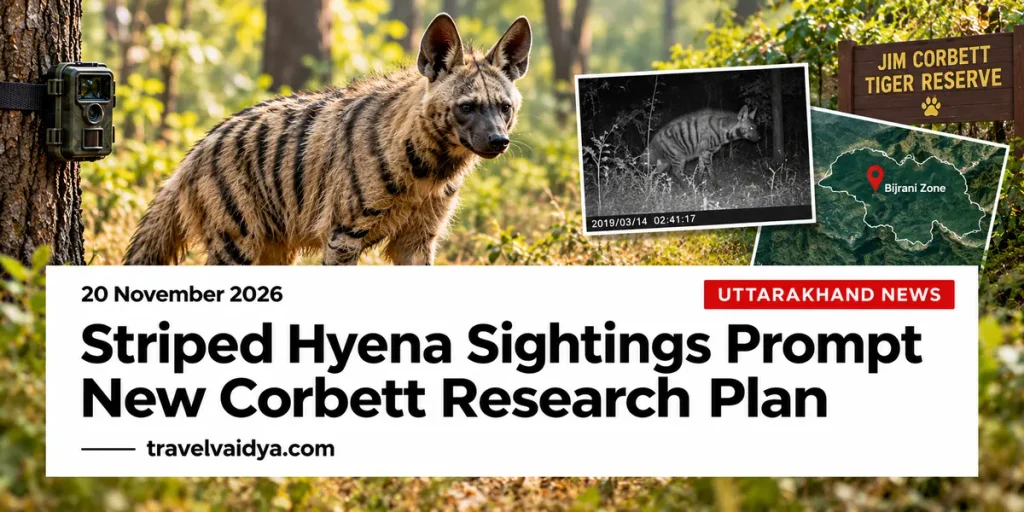
Deputy director Shirin Sanjay also referred to an earlier attempt to photograph hyenas using camera traps in the Bijrani area that did not produce the expected results.
The new observation provides a reason to investigate further, but a single sighting cannot establish the number of animals present or whether they breed within the reserve.
What Earlier Camera-Trap Surveys Revealed
Striped hyenas are not entirely new to the Corbett landscape.
Historical surveys and camera-trap records have documented their presence, although detections have varied between monitoring periods.
According to the November 2026 report, the species was photographed at seven camera-trap locations during a 2019 survey.
However, the referenced 2021–22 monitoring exercise did not record striped hyena photographs.
Why Missing Camera-Trap Images Do Not Prove Disappearance
Wildlife camera traps provide valuable evidence, but their results depend on placement, monitoring duration, animal movement and the probability of detection.
An animal may remain present in a landscape without passing a camera during a particular survey.
Therefore, the absence of striped hyena photographs in one monitoring period does not necessarily mean the species disappeared from Corbett.
Equally, a recent sighting should not be interpreted as proof that the population has increased.
Establishing population trends would require systematic monitoring over time.
What the June 2026 Scientific Study Says
A scientific paper published in the Journal of Threatened Taxa in June 2026 provides useful background to the latest reports.
Titled First Camera-trap Records of Three Wild Carnivores from Corbett Tiger Reserve, India, the study documents photographic evidence of striped hyenas, red foxes and Indian foxes from camera-trap data associated with national tiger-estimation exercises.
The researchers examined records of carnivores that receive considerably less public attention than tigers and leopards.
The paper demonstrates the importance of monitoring species that may occur infrequently or remain difficult to detect.
However, the documented records alone do not establish a stable striped hyena breeding population inside Corbett.
The researchers emphasise the need for continued investigation into habitat use, distribution and population status.
The original scientific paper provides an important evidence-based foundation for understanding why the latest sightings deserve attention.
Why Striped Hyenas Matter to Corbett’s Ecosystem
The striped hyena (Hyaena hyaena) is a predominantly nocturnal carnivore and scavenger found across parts of India, the Middle East and other regions.
Unlike the spotted hyena more commonly associated with African wildlife documentaries, striped hyenas generally live alone or in small family groups.
Their diet can include carrion, small animals and other available food resources.
Scavenging, Biodiversity and Conservation Status
Scavengers play an important ecological role by consuming animal remains and helping recycle nutrients within ecosystems.
Striped hyenas contribute to this process, making them valuable members of the wider carnivore community.
The species is classified as Near Threatened on the IUCN Red List and receives legal protection in India.
Habitat fragmentation, human disturbance, road mortality and conflict with people are among the broader conservation concerns affecting striped hyenas.
Understanding their presence in the Corbett landscape could help wildlife managers identify suitable habitats and areas where additional monitoring is needed.
What Researchers Still Need to Establish
The most important unanswered question is whether striped hyenas maintain a resident population within Corbett Tiger Reserve or move into the area occasionally from adjoining forests.
Future research could examine camera-trap detections, movement patterns, habitat characteristics and the availability of food resources.
Researchers would also need evidence of repeated occupation and breeding before making conclusions about a permanent population.
At present, there is no independently verified population estimate for striped hyenas in Corbett based on the newly reported observations.
The reported research initiative should therefore be understood as an effort to investigate the species, not proof that its numbers are increasing.
What Wildlife Tourists Should Know About Hyena Sightings
For visitors planning a safari in Jim Corbett, the reports offer an interesting reminder of the reserve’s ecological diversity.
However, striped hyenas are elusive animals, and sightings are unpredictable.
Travellers should not expect to see a hyena simply because forest staff have reported recent observations.
Wildlife viewing should always follow authorised safari routes, forest department instructions and responsible photography practices.
Visitors should avoid disturbing animals, leaving vehicles where prohibited or attempting to attract wildlife with food.
Those planning a visit can explore Travel Vaidya’s Jim Corbett travel guide for general destination information.
Beyond Tigers: Protecting Corbett’s Lesser-Known Wildlife
Jim Corbett’s reputation is closely linked to tiger conservation, but the reserve supports a much broader network of mammals, birds, reptiles and other wildlife.
Research into less frequently recorded carnivores can provide information about habitat connectivity and ecological relationships that tiger-focused monitoring alone may not fully explain.
The striped hyena observations offer an opportunity to strengthen scientific understanding of the landscape without overstating what the available evidence shows.
If systematic research confirms regular occupation, its findings could help inform future conservation priorities.
For now, the important development is that a rarely discussed species is receiving renewed attention.
The reported research plan, supported by earlier scientific records, could help clarify the striped hyena’s place in Corbett’s wildlife ecosystem while reminding visitors that the reserve’s conservation importance extends far beyond its famous tigers.