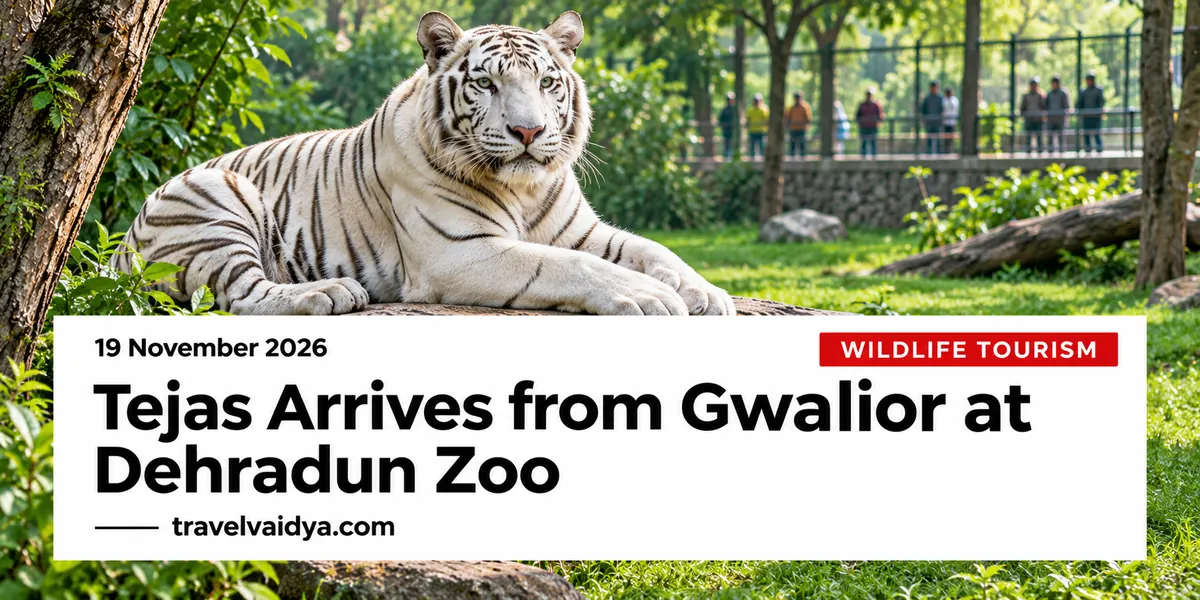
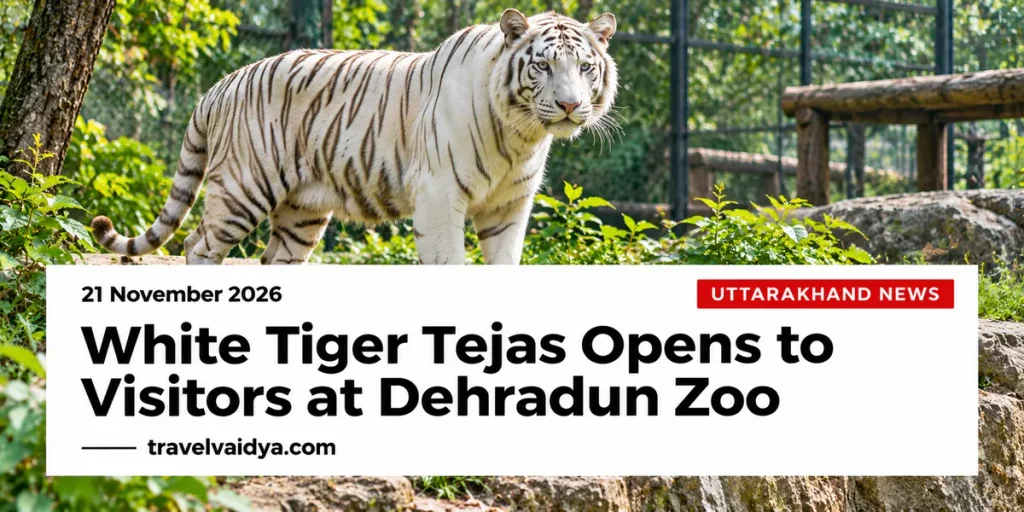
Dehradun, Uttarakhand | 21 November 2026: White Tiger Tejas Opens to Visitors at Dehradun Zoo, a new wildlife attraction with the public opening of an enclosure housing Tejas, a two-and-a-half-year-old male white tiger brought from Gwalior, Madhya Pradesh.
Uttarakhand Chief Minister Pushkar Singh Dhami inaugurated the enclosure at the zoo in Malsi on 19 November 2026, officially opening it for visitors. Tejas is reported to be the first white tiger housed at a zoo in Uttarakhand.
The development adds another attraction to Dehradun’s tourism circuit while drawing attention to wildlife conservation, environmental education and the role of zoological parks in helping visitors understand biodiversity.
The Chief Minister also announced free zoo entry for college students, extending an educational initiative previously available to children.
Dehradun Zoo Unveils White Tiger Tejas
Dehradun Zoo, located in the Malsi area along the Dehradun–Mussoorie corridor, welcomed visitors to Tejas’s newly inaugurated enclosure on Thursday, 19 November.
The inauguration marked the completion of preparations to introduce the white tiger to public viewing following his transfer from Gandhi Zoological Park in Gwalior.
According to PTI’s report published by ThePrint, Chief Minister Dhami said Tejas would enhance the zoo’s appeal and provide visitors with another opportunity to observe wildlife.
Chief Minister Inaugurates the New Enclosure
During the ceremony, Dhami emphasised the importance of balancing tourism development with environmental conservation.
He described Uttarakhand’s forests and biodiversity as valuable natural assets requiring protection.
Forest Minister Subodh Uniyal also highlighted the arrival of the white tiger as a development that could strengthen public interest in wildlife.
The opening represents an addition to the zoo’s existing attractions, although any increase in visitor numbers will need to be measured over time.
Who Is Tejas? Age, Origin and Arrival in Uttarakhand
Tejas is a male white tiger, approximately two-and-a-half years old.
He arrived at Dehradun Zoo on 28 September 2026 from Gandhi Zoological Park in Gwalior, covering approximately 556 kilometres during the transfer.
His arrival was part of a wildlife exchange programme approved by the Central Zoo Authority, according to The New Indian Express.
Under the exchange arrangement, Dehradun Zoo sent Bhola, an approximately five-year-old Royal Bengal tiger, to Gwalior.
Transfer, Quarantine and Preparation for Visitors
A 13-member team, including veterinarians and forest officials, accompanied Tejas during the journey in a specialised transport vehicle.
After reaching Dehradun, he underwent a 30-day quarantine period so zoo staff could monitor his health and adjustment to the new environment.
The quarantine ended on 28 October, after which Tejas was moved to the designated white tiger enclosure.
Zoo veterinary staff monitored his food intake, behaviour and general health during the transition.
Although Tejas had completed quarantine before November, public viewing began only after the formal inauguration of the enclosure on 19 November.
This distinction is important: his arrival in September did not mean that tourists could immediately see him.
Free Zoo Entry Announced for College Students
Alongside the enclosure inauguration, Chief Minister Dhami announced that college students would also be eligible for free entry to Dehradun Zoo.
The announcement extends an initiative that had previously provided free admission to children.
According to Amar Ujala’s report, the objective is to give students opportunities to learn about wildlife, biodiversity and environmental protection.
What Students Should Confirm Before Visiting
Although the announcement has been widely reported, detailed implementation conditions have not been independently confirmed.
College students should check with the zoo before travelling to establish whether the concession is operational, which identification documents are required and whether any eligibility restrictions apply.
Visitors should not assume that all admission charges have been removed or that the announcement automatically applies to every category of student.
Why Tejas Is Significant for Dehradun Tourism
Dehradun Zoo is an established attraction for families, students and tourists exploring Uttarakhand’s capital.
Its location makes it a convenient addition to itineraries combining Dehradun with Mussoorie and nearby attractions.
The arrival of Tejas may encourage additional interest among visitors who want to observe a white tiger in a managed zoological setting.
However, the zoo’s broader significance extends beyond the introduction of a single animal.
Educational displays, wildlife interpretation and conservation awareness can help visitors understand the ecological importance of species and habitats.
Visitor Numbers and Conservation Education
During the inauguration, Dhami stated that Dehradun Zoo attracts approximately 8.5 lakh visitors annually and generates revenue exceeding ₹7 crore.
These figures describe the zoo’s reported existing activity. They should not be interpreted as additional visitors or income generated by Tejas.
The government expects the new attraction to increase public interest, but no verified post-opening attendance figures are yet available.
The zoo can also provide opportunities for students to learn about animal behaviour, conservation challenges and the relationship between wildlife and natural ecosystems.
Visiting Dehradun Zoo: Location and Practical Information
Dehradun Zoo is situated in Malsi, on the road connecting Dehradun with Mussoorie.
For tourists staying in Dehradun, the zoo can be included in a local sightseeing itinerary. Travellers heading towards Mussoorie may also consider visiting, depending on their schedule.
Visitors should confirm the following details before departure:
- Current zoo opening hours and weekly closure arrangements.
- Adult and child admission fees.
- Whether the announced college-student concession has taken effect.
- Any specific viewing arrangements for the white tiger enclosure.
- Weather conditions and road traffic on the Dehradun–Mussoorie route.
The enclosure’s public opening does not guarantee that Tejas will be visible at every moment. Animal welfare, resting behaviour and enclosure management may affect viewing opportunities.
Responsible Wildlife Viewing at Malsi Zoo
White tigers are not a separate tiger species. Their pale colouring results from an inherited genetic variation affecting pigmentation.
Seeing Tejas offers an opportunity to learn about tiger biology, but it is important to distinguish a zoo experience from observing wild tigers in their natural habitat.
Visitors should avoid shouting, tapping barriers, using flash photography where prohibited or attempting to attract an animal’s attention.
Parents and teachers can also use the visit to discuss habitat conservation, the importance of biodiversity and the challenges faced by wild tiger populations.
Respecting enclosure boundaries and following zoo instructions helps maintain a safer environment for both animals and visitors.
A New Attraction With an Educational Purpose
The public opening of Tejas’s enclosure on 19 November marks a notable addition to Dehradun Zoo’s visitor experience.
His transfer from Gwalior, quarantine and introduction to public viewing reflect the preparations involved in bringing a new animal into a zoological collection.
For travellers, the white tiger offers another reason to include Malsi Zoo in a Dehradun itinerary.
For the zoo, the greater opportunity lies in combining visitor interest with meaningful wildlife education and responsible animal care.
As Tejas begins receiving visitors, the long-term value of the new attraction will depend not only on tourism interest but also on the quality of conservation awareness and animal welfare maintained at the facility.